Saturday, February 14, 2009

Emmanuel DeMerode: Exclusive Interview on Fate of Humans and Wildlife in CONGO

By: Georgianne Nienaber

Last week, a coalition of 100 humanitarian and human rights organizations called on John Holmes, the UN under-secretary-general for humanitarian affairs, to insist that protecting civilians be a top priority of the joint Congolese and Rwandan military operation in eastern Democratic Republic of Congo.

In a public letter to Holmes, the Congo Advocacy Coalition expressed “alarm that the joint military operation has to date contributed to the flight of thousands of people from their homes in anticipation of violence, adding to the 1.2 million already displaced in earlier waves of fighting. The coalition further raised concerns about reprisal killings and the use of civilians as human shields by the rebel Democratic Forces for the Liberation of Rwanda (FDLR), as well as reports of rape and looting by all sides,” according to a report issued by Human Rights Watch.

Fate turns on a dime in eastern Congo, and at this writing, CNDP rebel General Laurent Nkunda is under house arrest in Rwanda, a country that until now had supported his movement.

On January 20, 2009, the Congolese and Rwandan governments began a joint military operation against the FDLR, an armed group based in eastern Congo. The FDLR includes members of the Interahamwe, responsible for the 1994 genocide in Rwanda. If more fighting breaks out, the consequences for humans and the endangered mountain gorilla will be dire. Local sources on the ground in Virunga Park confirm that Rwandan battalions have passed near Rutshuru and Rumangabo, in the heart of Virunga National Park, but so far no major fighting has broken out.

While in DR Congo at the beginning of January, Australian journalist Helen Thomas and I met with Emmanuel de Merode and discussed the human/wildlife conflict there. De Merode is the new head of the endangered and embattled Park.


Thomas and I had just left Goma, when an email came in from de Merode. He had read our interview with CNDP leader Laurent Nkunda in the Huffington Post and wondered if we could talk. Ordinarily this kind of request would not seem unusual, but I had been a relentless critic of de Merode and his association with gorilla conservationists as former head of Wildlife Direct. The same article had been cross-posted on OPEDNEWS.

De Merode crossed the border into the Rwandan town of Gisenyi and we sat on a hotel veranda for almost two hours. After a half hour of wary sparring, it seemed to me at least that we had much more in common than we shared in disagreement. Had we both changed? Perhaps we had both grown weary of the senseless and relentless assaults on both humans and wildlife in the Kivus.


At one time I had shared de Merode's passionate commitment to the preservation of the mountain gorilla, but my concerns shifted once I visited DRC and saw that 1.2 million humans were in as much danger as the gorillas. Western news reports have focused on the gorillas above all human concerns.


My impression was that multi-national and strategic interests, including those of Rwanda, Uganda and Burundi, fueled by white supremacy and cloaked in the mantle of 'conservation,’” killed the mountain gorillas. De Merode took issue with that conclusion.

What follows is a summary of our recorded conversation and subsequent emails. Some of it is paraphrased and in the interest of the fate of humans and wildlife and hope that two former adversaries can present the truth for the good of Congo, I ran this past de Merode and he stands behind it.

On Criticism that Humans Need Access to the Resources of Virunga

The Issue: Due to the ongoing fighting in eastern DRC, massive relocation camps are now located on the perimeter of Virunga Park. People need fuel to cook and keep warm and up until now, there has been an effort to keep the displaced from Virunga. The UN High Commissioner for Refugees (UNHCR) estimates there are 60,000 people in camps at Kibati, just north of the flashpoint Nord-Kivu provincial capital of Goma.


De Merode: After being appointed as chief warden in August last year, we removed the charcoal barrier at Kibati. Prices in Goma dropped from 33 to 16 dollars a sack in the weeks that followed as a result of a massive increase in supply from the park. We are still trying to a solution to the considerable damage that is being inflicted on the park as a result of my decision to abandon the barrier, but please understand that I do not believe that the wildlife should take priority over people's needs.

You are right in claiming that, by focusing on charcoal, we are neglecting some of the more pressing humanitarian needs. But we have to look ahead. Virunga's forests cannot last more than 5 years with the amount of charcoal that is coming out of the park. When the forests are gone, Goma will suffer a massive energy crisis, and that will quickly become a humanitarian catastrophe: domestic energy is key to people's survival. They need domestic energy for food and for their health.

Charcoal is incredibly destructive and inefficient. When people cut the tree they only use the branches because they don't have the tools to cut the trunk and it is a huge amount of waste. We have to find an alternative. It's a human priority as much as it is a priority for the wildlife.

What we have been working on was to launch a biomass briquette program as an alternative to charcoal. I feel confident about it as a viable solution.

You know as well as anyone that these are the richest soils in all of Africa. What we are doing...and I would like to invite you to see this...we launched a briquette program and I feel confident about it. The Legacy Foundation in the United States developed the system whereby fuel is created from local products of grass, debris and sawdust.

One press creates employment for six people. If we can create 5000 presses, it would replace the charcoal demand of Goma, and create 30,000 sustainable jobs.

Everyone gets accused of being wrong here. Even you.


The Involvement of Elite Rangers in Human Rights Abuses


The Issue: There is a video that demonstrates human rights abuses by an elite group of Virunga Park Rangers who were trained by British mercenary Conrad Thorpe. The Frankfurt Zoological Society on behalf of Wildlife Direct funded the training. The video can be viewed on the internet.

De Merode:

People are not dying because of a lack of resources - it's not food insecurity or drought that is the root cause of suffering in eastern DRC, but deep physical insecurity - a level of brutality inflicted on an innocent population that knows no limits. This is a tragedy that stems from the total breakdown of law and order. Congolese people are hard working and resourceful, but what can you do when you are repeatedly attacked by bandits, when your crops are destroyed and your livestock pillaged, when your livelihood is destroyed.

The Congolese Parks authority is a law enforcement agency, and has a responsibility towards the state, and towards the people to uphold the law. I feel they fill an important function, but to do so, its staff have to be trained and equipped as law enforcement officers.

Shortly after being appointed I also made the decision to disband the "advance force". They were formally disbanded in November and have returned to their original positions as regular rangers. These were the 50 rangers trained by Conrad Thorpe and his team and who was, I believe, the subject of your concern. This draws a line through that training programme in 2005, but I would appreciate the links to the images that you refer to as abusive acts by the rangers so that I can look into it.

The issues you raised are valid and difficult.

The training you wrote about took place, but for the record, we (Wildlife Direct) did not actually fund the training. The Frankfurt Zoological Society funded it, but I was fully aware training was going on. That said, and while it has proven controversial, I would stand by my position that it is essential that rangers are properly trained. Given the state of insecurity in the areas in which they operate, they have to be adequately trained and supported. I would much prefer it if there was no need to carry rifles, but there is another side to this story which is that poachers in this part of the world can be very well armed and affluent and willing to kill. If rangers have to carry rifles, then we have a fundamental obligation to ensure that they are able to handle those weapons responsibly. That means having discipline, leadership, and a sense of responsibility. Those are qualities that can only be obtained through training.

As to your question about torture being acceptable: it is absolutely not acceptable under any circumstances.

I believe there have been proven cases of unacceptable excesses by park rangers in the past. I will not conceal the truth on that, nor will I try to justify it in any way, but bear in mind that for many years the rangers have been abandoned and left to their own devices, which is a recipe for disaster. We still have a long way to go, but more recently, where there have been proven cases of unacceptable behaviour, there have been convictions against rangers, and there are rangers in prison because of what you are talking about. Impunity is not something we will allow, and the rangers understand that.

What can I say? I can only agree with you about that.

If Conrad was present and there is torture on the tape he will never work in Virunga as long as I am here.

However, there is another side that poachers can be very well armed and affluent and willing to kill. Richard Leakey (De Merode's father-in law) did not at anytime request that we work in Virunga National Park. He has never set foot here. I wanted to and did so against all advice to the contrary.

I have been criticized for being a Belgian prince, but I have never lived in Belgium. I grew up in Kenya and was born 50 years after that horrific episode of Belgium's history, but I am Belgian and I will not apologize for it...it was the way I was born.

There are moral and pragmatic issues. The Congolese will decide for themselves, and unless we are much more effective in bringing them into environmental programs, we are shooting ourselves in the foot

From a moral standpoint all I can say is I have lived here for 15 years. I was trained as an anthropologist not a biologist. My first job was in Gambra. I lived in the villages north of Dungu, which have since been destroyed by the LRA (Lord's Resistenc Army) My work there in the seven years. I worked entirely in the communities.

We were trying to work with the local communities on the issue of bushmeat. My initial feeling, and I still believe that, was that the people should be able to eat bushmeat. These positions, which I published, did not always sit well with the conservation community. But it is not acceptable that local people living adjacent to national parks in countries like Congo should forfeit their resources for the sake of a global, largely western, community that cares dearly about African wildlife, but not quite enough to compensate the local people who have to bare the cost of conservation. It's very simple, if wildlife is that valuable to us, we have to compensate those who own those resources.


Walter Kansteiner

The Issue: There was no investigative scrutiny of the trustees of the Africa Wildlife Foundation, whose most prominent member was Walter Kansteiner III. Kansteiner is not a conservationist. He has over 20 years of experience in African and emerging market issues, advising corporations on mergers ranging from forestry, to mining to aviation. Kansteiner has publicly attacked South Africa's Nelson Mandela as a "Marxist." Kansteiner has also worked in the arena of strategic mineral procurement for the United States Defense Department. As of 2007, Kansteiner was listed on Source Watch (Center for Media and Democracy) as a director of Wildlife Direct, and Emmanuel de Merode identified Kansteiner as a board member in an email in 2007. Kansteiner has since vanished from the web links to Wildlife Direct. The Source Watch page was modified to remove Kansteiner in November 2007 after independent media reports linked him with Wildlife Direct.

De Merode: Regarding Kansteiner's association with mining interests in Congo... I wasn't aware of it. You are right, and that was a mistake on my part and a failure of due diligence.

If I had known, I think things would have been different from the start. But, I must stress that I do not believe that he that he has done anything illegal in Congo. If you tell me that he has then that is a very serious problem. Mineral exploitation is not by definition illegal. It's a pillar for development in Africa, and key to poverty alleviation. Nevertheless, I do feel that there should have been full disclosure of his involvement in mining in Ituri, given the realities of what went on in the Ituri at the time. So your sharp criticism in that regard was justified.

If he (Kansteiner) had interests in Moto Gold in the Ituri it should have been disclosed. It does not sit well with what we were trying to do in eastern Congo, and I regret having not picked up on that.

Relations With Tutsi General Laurent Nkunda


The Issue: Wildlife Direct went on the record, blaming Nkunda's men for the deaths of mountain gorillas beginning in January 2007. A communiqué issued by the Laurent Nkunda's CNDP denied any involvement, but the communiqué was squashed by conservation interests at the time. Since then, investigations indicated that the gorilla killings were an inside job by some Congolese conservation authorities.

Nkunda has remained a passionate defender of the gorillas and a visit to his compound indicated that all was well with the gorilla population there in CNDP controlled territory. In an interview, Nkunda told Thomas and I that the gorillas were "an important resource" for the Congolese people, and invited us to visit the gorillas if we wished. Time constraints, regrettably, did not allow for the visit.


De Merode: I had a brief meeting with Nkunda in January 2007 after the killings of the 2 solitary silverbacks. Between then and November 2008, we had no contact at all. I was working for Wildlife Direct at the time.

In September 2007 we evacuated the camp from Bukima in the gorilla sector because of the fighting, and the area was subsequently occupied by CNDP forces. Because we (Wildlife Direct) were in a formal partnership with ICCN, which is a government authority, we stayed out of CNDP territory. This was the case for most of ICCN's staff, who where based at Rumangabo, in government held territory. A small handful of 12 ICCN rangers stayed behind in CNDP territory and effectively broke contact with ICCN. They were under the command of an assistant warden called Kanamahalagi.

In May 2008 I resigned as CEO of wildlifedirect, when ICCN advertised the position of provincial director of ICCN for North Kivu, which includes the function of chief warden of Virunga. I applied, and on 8th August I was nominated to the position and sworn in as a government official a week later. At the time, I did have some very tentative contact with CNDP to explore the possibility of doing a gorilla census, but this was done through an intermediary, and I had no direct exchanges with Nkunda or with anyone from CNDP.

In October 2008 the major confrontations between CNDP and FARDC began, after which all of the southern of the park came under the control of CNDP. The fighting started at Rumangabo, where the combat was extremely violent, and we were all forced to evacuate to Goma. We had about 2000 staff and their families in Kitutu, then Bolengo IDP camps. We were faced with a very difficult situation, because we didn't have the funds to maintain so many people. The humanitarian community would not support ICCN staff or their families because they are a government law enforcement agency, and we started having serious health problems in the camp (3 cholera outbreaks, 2 deaths etc). Given the difficult situation, with all our people in the IDP camps in Goma and no prospects of getting humanitarian assistance to support them, we needed to find a way to get them back to their homes.

So in mid November, I made the decision to ask the Congolese Government to allow me to formally establish contact with Nkunda. I went to Kinshasa and met with the Minister of the Environment, Jose Endundu. He gave me his full (verbal) support (A few weeks later he later reiterated his support in front of several ambassadors during a press conference). The director of National Parks also gave me his support.

I returned to Goma and drove up to Rumangabo, after meeting with Kanamahalagi at Kibumba. We met with some senior officials of CNDP (Benjamin Mbonimpa and Dr Alex), and they arranged for me to meet with Nkunda the following day. I informed them that I would do so in uniform so that it was absolutely clear that I was working for the government. We met for about one and a half hours. I explained that we wanted to continue our work, within the constraints of a mandate that was strictly limited to conservation. I also explained that I was a government law enforcement officer and that I had been sworn an oath to the Congolese flag. He was very supportive, said that he understood that my hands were tied. He also said that he thought I would probably fail, but that he would support our efforts to protect the park. He added that he was from the area and that the benefits from the park to the local community were long overdue.


Since then, we have met several times. He also came once to Rumangabo, and we held quite extensive discussions on the development options and the situation of the national park. He is very supportive of the biomass briquette programme, of the schools that we have started to build in the area.

Our situation remains very fragile. We are the only government authority to be operating in rebel territory, and we could get thrown out at any moment by either side. I hope that our presence might have a stabilizing effect and may provide a catalyst for some community development, in spite of the ongoing conflict. It is a small example of the fact that there can be solutions to the differences that exist between government and rebels if a dialogue is established, and if, as you say, one reaches out. But perhaps I am being naive.

Are We Being Naïve?

The Issue: Can a solution be found to address the needs of humans and wildlife? Must there always be a conflict, or can common ground be found?
In an email, DeMerode offered the following quote, taken from an interview with him on NPR.

De Merode: The terrible tragedy that has affected the people of eastern Congo ... is the greatest tragedy that exists at the moment. And I think it should be at the top of everybody's agenda, whoever they are, to do whatever they can to resolve that issue above everything else, including the protection of the mountain gorillas. That's how I feel personally and I think that's what's shared by most people here.

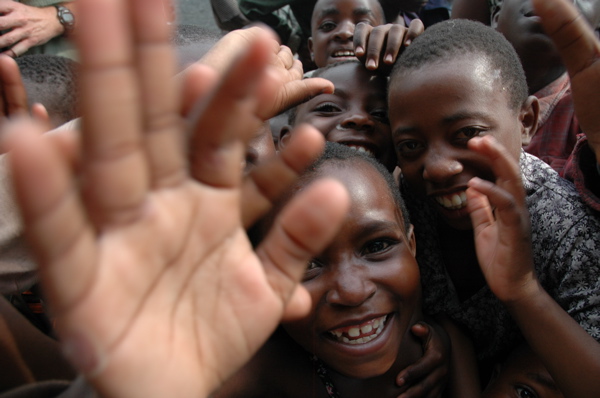
2009-01-21-Congo's Future-demerode_idp_2.jpg

Last week, we established Virunga's priorities for the year, which were published on the park's website.

I am glad we were able to meet, and I truly appreciate your willingness to keep an open mind. In a painful sort of way, you have affected our thinking, and I hope that you may one day see something good come out of our efforts, not just for gorillas.

(But, these are) Just words. The Congolese people will be the judges of whether the park is worth keeping.
~Emmanuel

Valentine's Day


WAR ON WANT--Fight Global Poverty....this is a war I want to fight.

I apologize for the "lateness" of this post....some of you may have already bought flowers for your special someone. If not, ask for a Fair Trade product somewhere.

Vote for the world you want with your dollars!!

Friday, February 13, 2009

Whoever forms gov, Israel moves right, pt1

Helen Thomas Inside the Press Room


We need more reporters and fewer stenographers in the White House Press Room.

If any of our readers believe that Helen Thomas is wrong please comment with a citation of the example of the corporate controlled lapdogs challenging the Bush Administration Propaganda that allowed Bush and Cheney to illegally invade Iraq.

Helen Thomas challenges Obama


Bush has managed to set the bar so so low....I'm almost "thrilled" that Obama called upon Helen Thomas and didn't simply ignore or simply forget to answer her second question. However, he did NOT answer the second question. He skillfully evaded the obvious truth that any knowledgeable American already knows....yes Israel has Nukes and then he cut her off from asking the all important follow up.

We need more journalists like Helen Thomas in the room so they will continue to push for answers to the tough questions.

Hopefully Helen will keep asking the question until Obama either answers the question or if Obama decides to ignore Helen (ala Bush). I'm hoping he will end up answering the question. Many of us are hoping Obama will rise to the challenge and steer our nation to a more honest discussion that doesn't avoid the elephant in the room.

The bottom line is that Obama will need to confront many issues pertaining Israel if he is going to live up to his promise. I'm hoping that it's a matter of timing and not simply a sign of being tied in to the thinking of the powerful elites good club.

Buzz...Buzz...

Thursday, February 12, 2009

Help Michael Moore's Bail Out Documentary

Wednesday, February 11th, 2009
Will You Help Me With My Next Film? ...a request from Michael Moore

Friends,

I am in the middle of shooting my next movie and I am looking for a few brave people who work on Wall Street or in the financial industry to come forward and share with me what they know. Based on those who have already contacted me, I believe there are a number of you who know "the real deal" about the abuses that have been happening. You have information that the American people need to hear. I am humbly asking you for a moment of courage, to be a hero and help me expose the biggest swindle in American history.

All correspondence with me will be kept confidential. Your identity will be protected and you will decide to what extent you wish to participate in telling the greatest crime story ever told.

The important thing here is for you to step up as an American and do your duty of shedding some light on this financial collapse. A few good people have already come forward, which leads me to believe there are many more of you out there who know what's going on. Here's your chance to let your fellow citizens in on the truth.

If you have any info that would help, please contact me at my private email address: bailout@michaelmoore.com.

For the rest of you on my email list who don't work in the financial industry, you're probably wondering, "What the heck is this all about? I thought he said he was making a romantic comedy!"

Well, I just can't say much right now. I'm sure you can understand why. One thing I can tell you is that you're gonna like this movie when I'm done with it. Oh, yeah...

So, again, if you work for a bank, a brokerage firm or an insurance company -- or if you have seen things or heard things that you believe the American people have a right to know -- please contact me at bailout@michaelmoore.com.

Thank you in advance for your help!

Yours,
Michael Moore
bailout@michaelmoore.com
MichaelMoore.com

Interview with Colonel Ann Wright, Retired, on Trip to Gaza


From Grit TV:

Retired US army colonel Ann Wright talks about her recent trip to Gaza. Throughout Israel's intensive war in Gaza, reporters and international observers have been barred from entering the region. Wright says that the damage is extensive and Israel's disproportionate response "criminal." During her visit to Egypt and Gaza, Philip Rizk, a 26 year old student of Middle Eastern Studies at the American University in Cairo was detained after participating in a rally in support of Gazans. Rizk has been an outspoken critic of the Israeli invasion and of the Egyptian government's feeble response to the suffering of Palestinian civilians. His whereabouts remain unknown and no formal charges have been issued. A demonstration in support of his release will take place on Wednesday, February 11 at 11:30 in front of the Egyptian Consulate in New York.

Wednesday, February 11, 2009

Congolese Midwives Struggle To Help Mothers Brutalized By War (SLIDESHOW) by Georgianne Nienaber

See the original article at Huffington Post.

*****


I hate the border crossing from Rwanda into Goma at Gisenyi. It frays nerves and sullies sunny dispositions in a heartbeat. Male street thugs prowl past luggage, waiting for that instant of inattention. Professional beggars steal into your personal space while the truly hungry are too afraid to ask for a franc or two, and the secret police pour over passports and personal possessions with imperious disregard for common courtesy.

Journalist Helen Thomas and a medical doctor from the States were joining me for a meeting with a midwife group from Goma, and we were waiting for my Congolese friend Omer to meet us with the required invitation from APROSAF (Action Pour la PROmotion de la Sage - Femme). I had not seen Omer in two years and cannot adequately express the relief I felt when I saw his round face and perpetual smile.


A Swahili welcome in song from the APROSAF midwives and mothers said it all. “Welcome and we wish you a long life.”

(To see the complete photoessay of 13 photos by Georgianne Nienaber, click here.)

After Omer smoothed the way through the border crossing, we piled into a small car and made our way through the mean lava streets of Goma to our hotel. It all looked familiar--nothing had changed in the two years since my last visit except for the increased MONUC (UN mission to DR Congo) visibility in the center of town.

It is a peculiar characteristic of Congolese society that people don't offer a request in a straightforward manner. Suggestions are made, and it is up to the listener to be sensitive to the fact that an offhand remark might actually be an important request. One of the young men helping us to get settled into our rooms mentioned to me that the volunteer APROSAF midwife group was having a meeting that afternoon. I asked Omer about it and he positively beamed, excited that we would consider attending. The doctor with us had brought medicines and supplies, so it seemed to us as good a time as any to deliver them, although we were all exhausted from work and travel.

After bouncing over streets filled with lava rock, we pulled into a school's parking area. Schools in this part of the world consist of a row of classroom doors facing a central area. Think of it as resembling an old-fashioned motel. What happened next was extraordinary and certainly an unforgettable experience for eyes and ears.

A whoop sounding for all the world like the battle cry of Native Americans in a B western, was followed by applause and a whirl of color as thirty to forty Congolese women, all singing and shouting in Swahili, poured through the door to one of the classrooms and surrounded us. Hands touching and hands holding reached for us. Eyes dancing with light and genuine welcome embraced us. These were the midwives. These were the brave women--the guardians of what remains of civilized society in Congo.

The midwives had been waiting hours for our arrival.

After the days we spent dodging drunken, angry men and opportunistic border guards, this was relief. This was healing. This also represented a personal sacrifice on the part of the midwives, some of who had hiked for miles to visit the American women writers and the male doctor who offered hope that they could find the tools they need to do their work.

Their work is simple and it is profound. The APROSAF midwives risk their own lives to bring new life into the world. An advisor to the Red Cross told us about them. Their lives are spent in service to the ancient rhythms of creation-- assisting the newborn and mothers. 45,000 people a month are dying from war-related caused in Congo, yet life refuses to capitulate to the war, and the midwives hold firmly to a banner of promise and hope. But they have nothing to work with. Their needs are simple by American standards of health care. Some textbooks, basic medical kits, which include surgical gloves, and a small clinic building for transfer cases and HIV counseling.

The classroom was arranged so that the visitors faced the midwives, our backs to the black slate board. The wooden benches and desks were tiny, with barely enough room for a notebook. Strong serious faces, some young, some older-- faces filled with expectation and wrapped in hats and scarves riotous with the colors of Africa watched as we fiddled with cameras and recorders. We were there to learn and it occurred to me that the classroom should have been arranged differently, with the visitors in the desks made for the students.

Doctor Kahavi Chrisogone, the APROSAF coordinator began the presentation Dr. Chrisogone has a regular practice at Heal Africa (The former DOCS Hospital) in Goma. In a quiet voice, Doctor Chrisogone outlined the pilot maternity project while Omer translated. The midwives need a small maternity center in Goma where they can bring pregnant women and rape cases in need of emergency care. All too often the pregnant woman and the rape victims are one and the same.

The midwives also risk rape and shootings to reach the women who need them.

Goma health authorities are supportive, feeling it necessary to find an adequate solution to risks faced by the newborn and mothers in the extreme wartime conditions of Nord Kivu Province.

Doctor Chrisogone completed his presentation, and what happened next was powerful and riveting. In response to a question from Thomas and myself: "What do the midwives want to say?" there was perhaps a minute of uncomfortable silence. Then, one after the other, in strong sure voices and demeanor, the midwives approached the head of the classroom and spoke to us through Omer.

There were tales of heinous abuse, gentle pleas for help, and simple requests.

There was no laughter this time. No smiling. Faces remained strong, but eyes welled up as the tales mounted and mounted until he listener felt that there was no way the stories could get worse, but they did. You could hear the murmurs of discontent while your head felt like it might explode from information that assaulted rational thought.

The dream of the midwives is simple by American standards. A ten-bed clinic with the supplies and capacity to deliver seven to ten babies a day. The pricetag? $112,000--the cost of ten good quality AK-47 assault rifles.

Tuesday, February 10, 2009

CEO bailouts? How about the homeowners?

Sidebar for this video:

The housing crisis is not just a problem for families facing foreclosure it is a problem for every homeowner in America. As long as foreclosures persist, home values will keep going down, and everyone loses.

We are collecting stories from people all over the country who have been hit by the housing crisis so we can show what is really happening on Main Street and we need your help. Have you been affected by the housing meltdown? Foreclosed on? Underwater? Trapped in a predatory loan? Do you know anyone else whose life has been turned upside down by the collapse of the real estate market? Record your story, or the story of a friend, family member, co-worker, or neighbor, and send it to us. Learn more at http://fightingforourhomes.com.

Wednesday, February 04, 2009

We will not go down (Song for Gaza)

Sidebar for this video:

The first American song and video clip about Gaza, it will shock you, this is a part of the truth about Palestine.
You can download a high quality version of this clip at :
http://www.3emara.net/Videos/Gaza.rar

Voice of the Wetlands Festival 2008, Part 2: Passion for Music and the Wetlands

I am continuing now with the series of articles I wrote about the threatened Louisiana wetlands and the related annual Voice of the Wetlands Festival, commencing in late October of 2008 for OpEdNews.com.

(To see Part 1 of the Mosquito Blog version, click here.)

Voice of the Wetlands Festival 2008, Part 2: Passion for Music and the Wetlands

By Mac McKinney

(Original Content for Part 2 is here)


Welcome to Houma, southern Louisiana

What is the Voice of the Wetlands Festival exactly? Well, the details are a little obscure, but the story starts with Tab Benoit, the well-known Cajun Blues singer who won the 2007 Contemporary Blues Male Artist of the Year and B.B. King Entertainer of the Year Awards. He grew up in the middle of Cajun country, Houma, Louisiana to be exact, although he was born in Baton Rouge on November 17, 1967, a passionate Scorpio for the astrologically inclined. He attended venerable old Vandebilt Catholic High, although school must have seemed secondary to his two true loves in life: the guitar and the wetlands. He started taking to both at an early, early age, including rope-swings overhanging the bayous, and has remained committed to both to this day, excelling with the one and struggling ferociously to save the other. And out of this intense emotional cauldron of music, art and deep love for Louisiana's wetlands was born the organization, Voice of the Wetlands.


Tab Benoit on guitar at the VOW Festival 2008, with Leon Medica on bass, right. CLICK ON THE IMAGE TO SEE THE ENTIRE PHOTO.


Vandebilt Catholic High on S. Hollywood Road, Houma, Louisiana, where Tab Benoit went to school.

Here are Tab's thoughts on his transformation to a wetlands activist:

Have you ever loved a place so much that you dedicate your life to saving it? You know, I believe that my highest calling is to be a steward of the environment. My first job was as a pilot. From up here the awful truth hits you: these wetlands are disappearing right before our eyes. The wetlands we've lost just since my parents were born is bigger than the whole state of Delaware. You see, coastal erosion in Louisiana picks everybody's pocket. (quoted from Hurricane on the Bayou)


This devastating realization drove Benoit to found, along with other concerned citizens, the Voice of the Wetlands in 2003, a nonprofit group dedicated to spreading the truth about Louisiana's disappearing coastline through, primarily, music. VOW, as they are also known, held their first music festival in 2004, well before Katrina struck, so they were already struggling to raise awareness about the relationship between hurricanes and wetlands loss. In fact, Tab was actually working with director Greg MacGillivray as one of the individuals highlighted on the 2006 IMAX documentary Hurricane on the Bayou, which was to be a critical look at what might happen if a large hurricane hit New Orleans. Just as they were wrapping up the movie, monstrous Katrina did hit New Orleans, life imitating art, compelling them to rewrite and reshoot the film to include Katrina as a living example of what can happen when the wetlands are dramatically reduced in a storm-prone region.

Here are the first paragraphs of Voice of the Wetland's mission statement:

"By redirecting the Mississippi River from it's natural flow, south Louisiana's wetlands are being taken over and destroyed by the stronger current of the Gulf of Mexico at an alarming rate. The loss of south Louisiana's wetlands contributes to the loss of our unique culture, our heritage, our wildlife, our people and their livelihood."

Voice Of the Wetlands (VOW) is an organization (click here for their website) that is made up strictly of volunteers who dedicate their talent, time and resources to bring global attention to south Louisiana and the world's coastal erosion problem.

Benoit expounds on this more fully in Hurricane on the Bayou:

"Well, basically what went wrong is that in the 1930s, well-meaning engineers (the Army Corps of Engineers) built levees or walls, so-to-speak, along the banks of the Mississippi to protect the farms from yearly floods. Those annual floods deposited the soil that rebuilt the wetlands. Now with those levees, that soil gets flushed into the ocean. All that brown in the ocean (aerial shot of brown-colored stream in the Gulf), soil that could be rebuilding the wetlands the way it used to, before we interfered with Mother Nature.

We also made a mistake by digging canals for boat navigation. These canals brought in saltwater from the ocean, killing the marsh grass and the trees. This whole forest (footage of wetlands forest) is now dead. Without the tree roots, erosion speeds up." (ibid.)


Tab is really referring, without naming names in the movie, to, primarily, the giant oil and gas companies and related industries, Shell, Exxon, Texaco, to name a few of the "land barons" in Louisiana who are responsible, according to the Gulf Restoration Network, for 40% to 60% of the wetlands loss, companies that for decades have been paying scant attention to the havoc they are wrecking on the environment while they pursue the bottom line, much like Great White Sharks swimming around in the ocean mindlessly devouring everything within sight and smell.

In fact, the Voice of the Wetlands itself has been criticized by another, older organization (which now calls itself, in a flash of jealousy rivalry, the "True Voice of the Wetlands") for being too timid in attacking these "sharks", the oil and gas companies, head on. This group is better known as SOWL, Save Our Wetlands, and one thing they are not is shy:

VOICE of the WETLANDS is SAVE OUR WETLANDS

Voice of the Wetlands is Save Our Wetlands and Save Our Wetlands is the true Voice of the Wetlands and the real Voice of the Wetlands. SOWL (http://saveourwetlands.org/) since 1974 has been fighting Louisiana politicians, U.S. Army Corps of Engineers, Levee Districts, and their corporate masters from developing wetlands into low lying areas extremely susceptible to hurricane tidal surges.

In the 70's-80's SOWL was a Voice of the Wetlands against the Eden Isle and Oak Harbor Subdivisions constructed over 5,200 acres of wetlands on the North Shore of Lake Pontchartrain, St. Tammany Parish, Slidell, Louisiana. SOWL lost this litigation, and thousands of homeowners were wiped out from the flood waters of Katrina.

SOWL was a Voice of the Wetlands against the Corps' and Orleans Levee District plans for their bogus Lake Pontchartrain and Vicinity Hurricane Barrier Project, which under guise of hurricane protection was actually going to destroy 28,000 acres of New Orleans east wetlands into the Orlandia Subdivision. SOWL won this litigation and saved on August 29,2005 over 60,000 future homes and over 100,000 families from flooding as a result of the Corps' disastrous Mississippi River Gulf Outlet (MR-GO). The September 28, 2005 Government Accountability Office (GAO) report stated 'if the barriers had been constructed the flooding in New Orleans would have been worst."

SOWL has always been a Voice of the Wetlands against Shell and its greasy allies from walking away from their obligation to remedy the coastal erosion caused by their 10,000 miles of oil company canals and navigational channels. SOWL in 1980's filed suit against Corps for refusing to conduct an Environmental Impact Study under the National Environmental Policy Act (NEPA) before issuing permis for oil canals. SOWL lost this litigation and in 2005, thousands of Louisiana citizens in St. Bernard, Plaquemines, Terrebonne, and Lafourche Parishes were flooded Hurricanes Katrina-Rita as a result of oil canal erosion........

SOWL is a Voice of the Wetlands against Shell's America's Wetlands spearheaded by its chairman R King Milling taking over as chairman of Coastal Protection Restoration Authority (CPRA) of Louisiana, and pushing an oil company propaganda campaign thru the coastal-political bowels of Louisiana. And so it goes. (Reference)


SOWL, we might say, is a get-in-the-trenches, lawsuit-filing, long-time political activist outfit, as distinct from VOW, the newer kid on the block, which prefers to spread its message primarily through education and music and hasn't chosen, as far as I know, to get heavily into the political/legal/lobbying arena. Whether they are going to feel compelled to in the future is another question. Logistically, this may be impossible since Benoit, president of VOW, is on the road performing most of the year, either with his own band or the Voice of the Wetlands All-Stars. In fact, being on the road is Tab's way of spreading his message. Everywhere he goes, he asks his audiences to get directly involved in learning about and then saving the wetlands by calling, not just writing, their government representatives. He invites you, me, everyone to come to Louisiana and see what is really going on, and then speak out about it. And just to show you how far Tab's voice has carried, he actually briefed a Congressional committee on Capitol Hill on the plight of the wetlands this past June, hammering home the point that the situation in southern Louisiana is a crisis for America.

Regarding both SOWL's and VOW's efforts, they are both important voices of the wetlands, and both are raising awareness of the devastation taking place in Louisiana and beyond in their own ways.

Solutions Anyone?

What is the solution to the wetlands crisis? Well, this is not rocket science. Tab explains what has to be done rather succinctly in Hurricane on the Bayou:

(Katrina) washed away another 100 square miles of soil. We should have been ready in New Orleans and we should have been ready down here. But we can do better. We already know how.

We'll have to plant hundreds of acres of mangrove and other soil-retaining plants, and some places it will take stone walls, and other spots, rebuilding with sand, sometimes again and again. And most importantly, engineers can use flood gates like this one (aerial shot of flood gate shown) and special pipe-lines and other innovative solutions to allow the muddy Mississippi to once more naturally replenish the wetlands. And as the huge cost of Katrina shows us, good stewardship of the environment is good economics too. (quoted from Hurricane on the Bayou)


There is also other huge problem that must also be addressed: the dramatic loss of barrier islands fronting the Mississippi River delta plain that reduce the effects of wave erosion, salinity intrusion and tidal currents on the wetlands themselves, as well as serving as a first defense in the path of a hurricane. The barrier islands must also be restored.

Just remember something else Tab says in the documentary: "Every three miles of wetlands reduces the height of a hurricane's storm surge by one foot." (ibid.) A couple of feet these days can mean the difference between life and death for thousands of people during a hurricane, so there is no time to waste in rebuilding what has been lost.


Encroached upon wetlands in Houma, Louisiana. Will America save them or let them be destroyed? CLICK ON THE IMAGE TO SEE THE ENTIRE PHOTO.

The big question now is, will an Obama Admininstration be willing to accept the challenge of restoring the wetlands? Let us hope so. I personally think something on the scale of the great 1930s Tennessee Valley Authority project would be in order to salvage the Gulf states.

Mighty Fine Music

Now let's pick up where I left off in Voice of the Wetlands Festival, Part 1, watching great bands play. On this warm to hot, sometimes cloudy, sometimes sunny Saturday, October 11, the sounds of rock, blues, and Cajun music roared or cajoled through the atmosphere all afternoon and into the night with bands such as Freddy and the Freeloaders:


Freddy and the Freeloaders, with Fred singing. The band has been around a long time, wowing crowd for decades across America with blues and country music. CLICK ON THE IMAGE TO SEE THE ENTIRE PHOTO.

During the intermission after Freddy left the stage, Congressman Charlie Melancon, 3rd District, Louisiana, got up and addressed the crowd. He was one of the few invited politicians who actually showed up, which is not a great omen for government involvement right now, but nonetheless, Charlie had some solid things to say about saving the wetlands. I talked to him briefly later about Ecuador's new Constitution and its Bill of Rights for Nature, which he hadn't heard about but was quite interested in, promising to have his staff look into it.


Congressman Charlie Melancon addressing the crowd about the wetlands

After Charlie was done, the spectacular Josh Garrett Band hit the stage. Josh was a real guitar magician Saturday, wailing away with his band on some hot and heavy Blues numbers.


Josh Garrett pouring it on with his guitar. CLICK ON THE IMAGE TO SEE THE ENTIRE PHOTO.

After Garrett's intense and sweat-filled performance, the Mike Zito Band from Nederland, Texas, took the stage. Actually Mike was raised in St. Louis, where he was exposed to all those powerful southside Blues influences, but gradually developed his own unique style, eventually settling in Southwest Texas. He has a classic Blues voice.


Mike Zito on the left, belting out a song. CLICK ON THE IMAGE TO SEE THE ENTIRE PHOTO.

Zito was followed by one of the longtime Bluesmen in American music, Jimmy Hall, out of Nashville, Tennessee, originally singing and playing with famous Wet Willie in the 70s, then solo performing for a time, then working with Hank Williams Jr. and Jeff Beck, and now varying his performances and recordings between different groups and his own bands.

The great Blues singer, harmonica player and sax man, Jimmy Hall, with dynamic guitarist Ronnie Fruge to his right. CLICK ON THE IMAGE TO SEE THE ENTIRE PHOTO.

Voice of the Wetlands All-Stars

At this point my wife and I left the festival for a couple of hours to have dinner with some friends, and when we came back, the last big gig of the evening was just starting, the traditional Voice of the Wetlands All-Stars set. The Voice of the Wetlands All-Stars was also created in 2003 by Benoit as an artistic vehicle for spreading the word about the Wetlands as they tour, near and far. The illustrious, official members of the band, beyond the many guest performers who play with them, are Big Chief Monk Boudreaux, Waylon Thibodeaux, George Porter, Jr., Johhny Vidacovich, Anders Osborne, Dr. John, Cyrille Neville, Tab Benoit and Jumpin Johhny Sasone. Click here for more info about the All-Stars.

Tonight the famous band, Louisiana's LeRoux, best known for their song, New Orleans Ladies, actually led off the final set, but never really left the stage, instead merging with the players representing the Voice of the Wetlands All-Stars during this festival, who began filtering onto the stage one at a time: Jumpin Johnny Sasone, Tab Benoit, Jimmy Hall and others, and, in a sweepingly grand entrance, Big Chief Monk Boudreaux of the Mardi Gras Indians, dressed in fantastic Indian attire and headdress. Southdown Plantation was rocking madly in the night by the time Big Chief finished his number, and so it went until the end of the set.


Tab Benoit left, Jimmy Hall center, Leon Medica right. The VOW All-Stars had Southdown Plantation rocking Saturday night. CLICK ON THE IMAGE TO SEE THE ENTIRE PHOTO.


More of the VOW All-Stars: Hall on sax, Terry Brock (Louisiana's LeRoux) singing. CLICK ON THE IMAGE TO SEE THE ENTIRE PHOTO.

This would be the end of the festival this year for my wife and I, because we were going to have to fly out of New Orleans early Sunday afternoon, and with the festival reopening at Noon, there was no way we could hang around that late. Besides, I had to drive back to the Lower Ninth Ward, but more on that later.

I would also meet, driving back up highway 90, a very interesting Cajun gentleman by the name of Lee Richoux. More on him in Part 3.

By the way, if you would like to look at my photo album of the Voice of the Wetlands Festival, 2008, plus some interesting shots of southern Louisiana, click here to go to my Kodak Gallery webpage. Once there, just click on VIEW SLIDESHOW. You do not have to sign in.

*************

Tuesday, February 03, 2009

Guest Editorial: Under the Black Flag by Uri Avnery

Guest Editorial from OpEdNews.com by Uri Avnery, Israeli writer, ex-Israeli soldier and now peace activist with Gush Shalom:

Israeli War Crimes

Under the Black Flag


(Click here for original article.)

By URI AVNERY


A Spanish judge has instituted a judicial inquiry against seven Israeli political and military personalities on suspicion of war crimes and crimes against humanity. The case: the 2002 dropping of a one ton bomb on the home of Hamas leader Salah Shehade. Apart from the intended victim, 14 people, most of them children, were killed.

For those who have forgotten: the then commander of the Israeli Air Force, Dan Halutz, was asked at the time what he feels when he drops a bomb on a residential building. His unforgettable answer: “A slight bump to the wing.” When we in Gush Shalom accused him of a war crime, he demanded that we be put on trial for high treason. He was joined by the Prime Minister, Ariel Sharon, who accused us of wanting to “turn over Israeli army officers to the enemy”. The Attorney General notified us officially that he did not intend to open an investigation against those responsible for the bombing.

I should be happy, therefore, that at long last somebody is ready to put that action to a judicial test (even if he seems to have been thwarted by political pressure.) But I am sorry that this has happened in Spain, not in Israel.

* * *

ISRAELI TV VIEWERS have lately been exposed to a bizarre sight: army officers appearing with their faces hidden, as usual for criminals when the court prohibits their identification. Pedophiles, for example, or attackers of old women.

On the orders of the military censors, this applies to all officers, from battalion commanders down, who have been involved in the Gaza war. Since the faces of brigade commanders and above are generally known, the order does not apply to them.

Immediately after the cease-fire, the Minister of Defense, Ehud Barak, promoted a special law that would give unlimited backing by the state to all officers and soldiers who took part in the Gaza war and who might be accused abroad of war crimes. This seems to confirm the Hebrew adage: “On the head of the thief, the hat is burning”.

* * *

I DO NOT object to trials abroad. The main thing is that war criminals, like pirates, should be brought to justice. It is not so important where they are caught. (This rule was applied by the State of Israel when it abducted Adolf Eichmann in Argentina and hanged him in Israel for heinous crimes committed outside the territory of Israel and, indeed, before the state even existed.)

But as an Israeli patriot, I would prefer suspected Israeli war criminals to be put on trial in Israel. That is necessary for the country, for all decent officers and soldiers of the Israeli army, for the education of future generations of citizens and soldiers.

There is no need to rely on international law alone. There are Israeli laws against war crimes. Enough to mention the immortal phrase coined by Justice Binyamin Halevy, serving as a military judge, in the trial of the border policemen who were responsible for the 1956 massacre in Kafr Kassem, when dozens of children, women and men were mown down for violating a curfew which they did not even know about.

The judge announced that even in wartime, there are orders over which flies “the black flag of illegality”. These are orders which are “manifestly” illegal – that is to say, orders which every normal person can tell are illegal, without having to consult a lawyer.

War criminals dishonor the army whose uniform they wear – whether they are generals or common soldiers. As a combat soldier on the day the Israeli Defense Army was officially created, I am ashamed of them and demand that they be cast out and be put on trial in Israel.

My list of suspects includes politicians, soldiers, rabbis and lawyers.

* * *

THERE IS not the slightest doubt that in the Gaza war, crimes were committed. The question is to what extent and by whom.

Example: the soldiers call on the residents of a house to leave it. A woman and her four children come out, waving white handkerchiefs. It is absolutely clear that they are not armed fighters. A soldier in a near-by tank stands up, points his rifle and shoots them dead at short range. According to testimonies that seem to be beyond doubt, this happened more than once.

Another example: the shelling of the United Nations school full of refugees, from which there was no shooting – as admitted by the army, after the original pretexts were disproved.

These are ”simple” cases. But the spectrum of cases is far wider. A serious judicial investigation has to start right from the top: the politicians and senior officers who decided on the war and confirmed its plans must be investigated about their decisions. In Nuremberg it was laid down that the starting of a war of aggression is a crime.

An objective investigation has to find out whether the decision to start the war was justified, or if there existed another way of stopping the launching of rockets against Israeli territory. Without doubt, no country can or should tolerate the bombing of its towns and villages from beyond the border. But could this be prevented by talking with the Gaza authorities? Was our government’s decision to boycott Hamas, the winner of the democratic Palestinian elections, the real cause of this war? Did the imposition of the blockade on a million and a half Gaza Strip inhabitants contribute to the launching of the Qassams? In brief: were the alternatives considered before it was decided to start a deadly war?

The war plan included a massive attack on the civilian population of the Strip. The real aims of a war can be understood less from the official declarations of its initiators, than from their actions. If in this war some 1300 men, women and children were killed, the great majority of whom were not fighters; if about 5000 people were injured, most of them children; if some 2500 homes were partly or wholly destroyed; if the infrastructure of life was totally demolished – all this clearly could not have happened accidentally. It must have been a part of the war plan.

The things said during the war by politicians and officers make it clear that the plan had at least two aims, which might be considered war crimes: (1) To cause widespread killing and destruction, in order to “fix a price tag”. “to burn into their consciousness”, “to reinforce deterrence”, and most of all – to get the population to rise up against Hamas and overthrow their government. Clearly this affects mainly the civilian population. (2) To avoid casualties to our army at (literally) any price by destroying any building and killing any human being in the area into which our troops were about to move, including destroying homes over the heads of their inhabitants, preventing medical teams from reaching the victims, killing people indiscriminately. In certain cases, inhabitants were warned that they must flee, but this was mainly an alibi-action: there was nowhere to flee to, and often fire was opened on people trying to escape.

An independent court will have to decide whether such a war-plan is in accordance with national and international law, or whether it was ab initio a crime against humanity and a war-crime.

This was a war of a regular army with huge capabilities against a guerrilla force. In such a war, too, not everything is permissible. Arguments like “The Hamas terrorists were hiding within the civilian population” and “They used the population as human shields” may be effective as propaganda but are irrelevant: that is true for every guerrilla war. It must be taken into account when a decision to start such a war is being considered.

In a democratic state, the military takes its orders from the political establishment. Good. But that does not include “manifestly” illegal orders, over which the black flag of illegality is waving. Since the Nuremberg trials, there is no more room for the excuse that “I was only obeying orders”.

Therefore, the personal responsibility of all involved - from the Chief of Staff, the Front Commander and the Division Commander right down to the last soldier - must be examined. From the statements of soldiers one must deduce that many believed that their job was “to kill as many Arabs as possible”. Meaning: no distinction between fighters and non-fighters. That is a completely illegal order, whether given explicitly or by a wink and a nudge. The soldiers understood this to be “the spirit of the commander”.

* * *

AMONG THOSE suspected of war crimes, the rabbis have a place of honor.

Those who incite to war crimes and call upon soldiers, directly or indirectly, to commit war crimes may be guilty of a war crime themselves.

When one speaks of “rabbis”, one thinks of old men with long white beards and big hats, who give tongue to venerable wisdom. But the rabbis who accompanied the troops are a very different species.

In the last decades, the state-financed religious educational system has churned out “rabbis” who are more like medieval Christian priests than the Jewish sages of Poland or Morocco. This system indoctrinates its pupils with a violent tribal cult, totally ethnocentric, which sees in the whole of world history nothing but an endless story of Jewish victimhood. This is a religion of a Chosen People, indifferent to others, a religion without compassion for anyone who is not Jewish, which glorifies the God-decreed genocide described in the Biblical book of Joshua.

The products of this education are now the “rabbis” who instruct the religious youths. With their encouragement, a systematic effort has been made to take over the Israeli army from within. Kippa-wearing officers have replaced the Kibbutzniks, who not so long ago were dominant in the army. Many of the lower and middle-ranking officers now belong to this group.

The most outstanding example is the “Chief Army Rabbi”, Colonel Avichai Ronsky, who has declared that his job is to reinforce the “fighting spirit” of the soldiers. He is a man of the extreme right, not far from the spirit of the late Rabbi Meir Kahane, whose party was outlawed in Israel for its fascist ideology. Under the auspices of the army rabbinate, religious-fascist brochures of the ultra-right “rabbis” were distributed to the soldiers.

This material includes political incitement, such as the statement that the Jewish religion prohibits “giving up even one millimeter of Eretz Israel”, that the Palestinians, like the Biblical Philistines (from whom the name Palestine derives), are a foreign people who invaded the country, and that any compromise (such as indicated in the official government program) is a mortal sin. The distribution of political propaganda violates, of course, army law.

The rabbis openly called upon the soldiers to be cruel and merciless towards the Arabs. To treat them mercifully, they stated, is a “terrible, awful immorality”. When such material is distributed to religious soldiers going into war, it is easy to see why things happened the way they did.

* * *

THE PLANNERS of this war knew that the shadow of war crimes was hovering over the planned operation. Witness: the Attorney General (whose official title is “Legal Advisor to the Government”) was a partner to the planning. This week the Chief Army Attorney, Colonel Avichai Mandelblut, disclosed that his officers were attached throughout the war to all the commanders, from the Chief of Staff down to the Division Commander.

All this together leads to the inescapable conclusion that the legal advisors bear direct responsibility for the decisions taken and implemented, from the massacre of the civilian police recruits at their graduating ceremony to the shelling of the UN installations. Every attorney who was a partner to the deliberations before an order was given is responsible for its consequences, unless he can prove that he objected to it.

The Chief Army Attorney, who is supposed to give the army professional and objective advice, speaks about “the monstrous enemy” and tries to justify the actions of the army by saying that it was fighting against “an unbridled enemy, who declared that he ‘loves death’ and finds shelter behind the backs of women and children”. Such language is, perhaps, pardonable in a pep-talk of a war-drunk combat commander, like the battalion chief who ordered his soldiers to commit suicide rather than be captured, but totally unacceptable when it comes from the chief legal officer of the army.

* * *

WE MUST pursue all the legal processes in Israel and call for an independent investigation and the indictment of suspected perpetrators. We must demand this even if the chances of it happening are slim indeed.

If these efforts fail, nobody will be able to object to trials abroad, either in an international court or in the courts of those nations that respect human rights and international law.

Until then, the black flag will still be waving.

Monday, February 02, 2009

Iraq's Shocking Human Toll: Perhaps 1 Million Killed, 4.5 Million Displaced, 1-2 Million Widows, 5 Million Orphans

From an article posted on OpEdNews.com (click here for original)

We are now able to estimate the number of Iraqis who have died in the war instigated by the Bush administration. Looking at the empirical evidence of Bush's war legacy will put his claims of victory in perspective. Of course, even by his standards--"stability"--the jury is out. Most independent analysts would say it's too soon to judge the political outcome. Nearly six years after the invasion, the country remains riven by sectarian politics and major unresolved issues, like the status of Kirkuk.

We have a better grasp of the human costs of the war. For example, the United Nations estimates that there are about 4.5 million displaced Iraqis--more than half of them refugees--or about one in every six citizens. Only 5 percent have chosen to return to their homes over the past year, a period of reduced violence from the high levels of 2005-07. The availability of healthcare, clean water, functioning schools, jobs and so forth remains elusive. According to Unicef, many provinces report that less than 40 percent of households have access to clean water. More than 40 percent of children in Basra, and more than 70 percent in Baghdad, cannot attend school.

The mortality caused by the war is also high. Several household surveys were conducted between 2004 and 2007. While there are differences among them, the range suggests a congruence of estimates. But none have been conducted for eighteen months, and the two most reliable surveys were completed in mid-2006. The higher of those found 650,000 "excess deaths" (mortality attributable to war); the other yielded 400,000. The war remained ferocious for twelve to fifteen months after those surveys were finished and then began to subside. Iraq Body Count, a London NGO that uses English-language press reports from Iraq to count civilian deaths, provides a means to update the 2006 estimates. While it is known to be an undercount, because press reports are incomplete and Baghdad-centric, IBC nonetheless provides useful trends, which are striking. Its estimates are nearing 100,000, more than double its June 2006 figure of 45,000. (It does not count nonviolent excess deaths--from health emergencies, for example--or insurgent deaths.) If this is an acceptable marker, a plausible estimate of total deaths can be calculated by doubling the totals of the 2006 household surveys, which used a much more reliable and sophisticated method for estimates that draws on long experience in epidemiology. So we have, at present, between 800,000 and 1.3 million "excess deaths" as we approach the six-year anniversary of this war.

Wednesday, January 28, 2009

Giant Demonstrations to Free Nkunda in Congolese Refugee Camps


Gen Nkunda, in the middle, speaking at his eastern Congolese compound on Jan 3, 2009 prior to being detained by the Rwandan military. (photo by G. Neinaber)


There have been large demonstrations in several Rwandan-run Congolese refugee camps in support of General Laurent Nkunda, chairman of the CNDP, after Rwandan authorities detained him under some sort of "house arrest", apparently deceitfully, while he was attending a joint meeting with them. This is according to people on the ground in contact with independent journalist Georgianne Nienaber, who has been staying on top of the evolving situation, as well as according to the BBC.

Nienaber has received several messages recently, which she has now conveyed to me. Here is one communique from one of the camps. I have modified the punctuation and capitalization to make it easier to read:

thanks Georgianna,

We do not know we will pay you back, but God knows to do it in a better way than us. I tried to get you some photos but I couldn't because of the police. No one can enter the 2 camps anymore. It (is) surrounded by soldiers and police, but refugees decided to go on demonstrating until they release their leader,and yes this has an important effect on the world.

Maybe with this, people will realize that Nkunda is not a criminal as everyone said, and everyone here does support NKunda, but people are scared. No one can say it aloud, people are angry but there is no place to express it. That (is) why we need you, Georginna.

I'll get some more news this evening. A journalist from suede (sic) reached the camp yesterday but the police catch her and they deleted all the photos she has taken.

May God bless you Georgianna

*********

Here is a second dispatch sent to Ms. Nienaber:

”Release Major-General Laurent Nkunda MIHIGO”, was one of the main message of Congolese living in refugee camps in Byumba and Kibuye on Sunday January 25, 2009. In fact, more than 45,000 Congolese gathered in their camps in Byumba and Kibuye (Rwanda) for a peaceful march and a strong message to the Rwandan government, asking for the unconditional release of General Laurent Nkunda Mihigo was sent out.

In chanting the slogan of the day,''Release our Leader, we ask for our Leader'', the demonstrators from the Byumba camp, escorted by the police and the army gathered in their game plot before walking around the whole camp to express their dissatisfaction against the Government of Rwanda after the arrest of Major-General Laurent Nkunda Mihigo.

On the signs, it was writen:''We condemn the arbitrary arrest of Major General Laurent Nkunda”, “we have lost the hope of returning home" and “We denounce all the traitors of the nation; allies of the evil forces”. The peaceful march started at 11.00, was covered by some foreign media and ended at 15:00 without incident.

However, in Kibuye, the peaceful march started at 8:00 but was disrupted by a Police Officer who wanted to arrest a demonstrator. A fight between demonstrators and the police followed, the latter shot into the crowd injuring a girl in the arm. According to preliminary information, the girl was between life and death.

The angry demontrators beat the Police Offistate. The refugees’ anger continued until evening, when they burned all the houses of policemen guarding the camp. The Rwandan army intervened and several arrests are reported.

*********

Finally, here is an excerpt from a BBC report confirming that massive demonstrations have indeed taken place in support of Nkunda.

Rwanda Puts Down Nkunda Dissent

(original at: http://www.opednews.com/populum/linkframe.php?linkid=81321)

Security has been tightened at refugee camps in Rwanda after protests calling for rebel Laurent Nkunda's release.

Gen Nkunda, who claimed his fighters were protecting the Tutsi community in the Democratic Republic of Congo, was arrested by Rwanda last week.

A joint force of Rwandan police and soldiers put down the protests mainly by Congolese Tutsis, on Sunday - reportedly using live bullets.

Correspondents says demonstrations against the government are very rare.

A Tutsi like Rwanda's leaders, Gen Nkunda had guarded Rwanda's western flank against attacks from ethnic Hutu Interahamwe militias who fled there after the Rwandan genocide of 1994.

But in a change of policy, he was arrested after being invited by Rwanda to discuss a joint military force from both countries against Hutu forces.....(For the full article, click here.)

Dilbert's Foreclosure

Dilbert.com

Riz Khan Interviews Daniel Barenboim on the Gaza Debacle - Jan 26

Why isn't Daniel Barenboim running for office in Israel? He has more sense in his baton hand than there is in the entire Israeli cabinet.

Sidebar for this video:

Riz is joined by Daniel Barenboim and Stephen Hawking, two geniuses of their respective fields who are calling for a solution on Gaza - from outside the political system.

Tuesday, January 27, 2009

Real Life Need for Unions

Dilbert says it as well as I could.....

my apologies I should have previewed first...the comic wouldn't fit on our blog.....sigh...it's NOT monday? oh my....

Monday, January 26, 2009

Sponser a CEO

Come on America, let's show how big our hearts are. Sponsor a bankrupt CEO.

Unedited Interview with General Laurent Nkunda: Parts 2 thru 4

In early January, Georgianne Nienaber and Helen Thomas, rather courageous and enterprising independent journalists, traveled to the compound of General Laurent Nkunda, charismatic leader of the rebel CNDP (National Congress for the Defense of the People) in the eastern Congo to interview him. They had become suspicious that a great many demonizing myths and groundless allegations had been hurled against him, and they wanted to get to the truth about the General if at all possible.

The CNDP, for those of you who don't know, has been one of the key protagonists in the ongoing and bloody conflict in the Congo, and has been a very disciplined and effective military force.

General Nkunda, however, has been getting a large amount of negative press in the mainstream media, and has been accused of massacres and war crimes, even the killing of endangered Congolese gorillas.

In the past few days, after the Rwandan government, which had been loosely allied with Nkunda, forged an agreement, whose details we do not fully know yet, with President Joseph Kabila of the DR Congo, a shift in alliances subsequently took place and Nkunda suddenly found himself isolated, on January 23, by the Rwandan military. At first the reports were that he was arrested. Now the term is "house arrest". At first there were deep concerns that he might be extradited to the DR Congo, where the Congolese government has already been making serious war crimes charges against him. However, how really true are these charges, or might they just be a contrived attempt to railroad Nkunda and eliminate him?

In reality, it seems that the Rwandan military still considers Nkunda a figure to be respected, if for no other reason than the powerful support he can command, and might be loath to toss a former key asset to President Kabila's wolves in Kinshasa. (For the latest on Gen Nkunda's "house arrest" as of January 26, click here.)

There are already reports coming out of Africa of popular riots and demonstrations against his detention, which reports fly in the face of the monstrous picture some detractors have painted of Nkunda. If he is a super-villain, you would think we would be reading about celebrations in the streets voer his arrest.

So, what is the truth about the man? Rarely is Nkunda's side of the story heard in the West, so here is an opportunity to hear it directly from the horse's mouth in Parts 2 thru 4. You, the reader, be the judge, instead of allowing pundits and newscasters to decide for you. Part 1 was posted earlier. You can watch it by clicking here.

So here is more of the interview, Parts 2 thru 4, with more forthcoming.


Part 2


Part 3


Part 4


Gaza in Ruins: A news special - Part 3 - 23 Jan 09

Video sidebar:

Part three of Al Jazeera's news special from the Gaza Strip.

The ultimate goal for virtually everybody in Gaza is to get on with the business of achieving an independent Palestinian state.

We examine the main political players, and who could possibly unite all the Palestinian factions in order to move forward.

Sunday, January 25, 2009

Gaza in Ruins: A news special - Part 2 - 23 Jan 09

Video sidebar:

Part two of Al Jazeera's news special from the Gaza Strip.

Gaza lies in physical and psychological ruins once again. The cost of rebuilding is likely to run into billions of dollars according to the UN.

Unedited Interview with General Laurent Nkunda Part I of 6

Georgianne Nienaber and Helen Thomas, independent journalists, traveled to the compound of General Laurent Nkunda, charismatic leader of the rebel CNDP (National Congress for the Defense of the People) in the eastern Congo. The CNDP, for those of you who don't know, has been one of the key protagonists in the ongoing and bloody conflict in the Congo, and has been a very disciplined and effective military force.

General Nkunda, however, has been getting a large amount of negative press in the mainstream media, and has been accused of massacres and war crimes, and even the killing of endangered Congolese gorillas.

In the past few days, after the Rwandan government, which had been loosely allied with Nkunda, forged an agreement, whose details we do not fully know yet, with President Joseph Kabila of the DR Congo, a shift in alliances subsequently took place and Nkunda suddenly found himself arrested by the Rwandan military. He may now face extradition to the Congo, where the government has already been making serious war crimes charges against him. However, how really true are these charges, or might they just be a contrived attempt to railroad Nkunda?

Rarely is his side of the story heard in the West, so here is an opportunity to hear it directly from him.

Since Miss Nienaber has written extensively about African gorillas, the interview actually begins with that topic before moving on to other subjects.

Saturday, January 24, 2009

Buzz--Listen to the Children NOT so=called Financial Gurus


Doesn't this sound familiar?
We have the potential to deliver abundant broadband capacity at prices we all can afford. Yet Americans consumers pay far too much for far too little compared to citizens in other countries. We have the eighth-highest monthly rates for broadband service among leading developed nations In real terms, this means Internet users in Japan pay about half the price for an Internet connection that’s 20 times faster than what’s commonly available to people in the United States.

Get connected with Internet for everyone.

Buzz--Obama's No Change Stimulus Plan


Thanks Heavens someone is asking good questions....Can we clone Rachel and put a few like her into the White House Press Pool?

The House voted to stop the release of the remaining no strings attached 350 billion dollars. Unfortunately the Senate did not vote to stop the funding of this horrible bill.

ONLY 8% for our highway roads, bridges and tunnels....Obama sure talked big about infrastructure but he's NOT doing what h promised. The House and Senate should pass a bill stopping the 350 billion and pass a bill that funds infrastructure only until they can plan what to do with the rest of the money. Make 25%-50% of the money available immediately for infrastructure projects that can get started now. STOP giving the money to the crooks in the banking and financial industry that got us into this disaster....aka Larry Summers...will NOT get us out.

Unfortunately I am still not seeing any progressive concrete actions concerning our economy...Obama and his administration have a golden opportunity to get it right....I'm afraid he's going to prefer compromise to successful action.

Obama is smart so who the heck is he working for? Us or the Larry Summer financial types that got us into this mess?

Buzz....Buzz....Buzz....

Even Hutus Dispute Charges that Tutsi General Nkunda Committed Atrocities in Kiwanja

Although Rwandan forces have indeed just arrested General Nkunda after, apparently, some deal was cut with the DR Congo, it is not clear whether they will extradite him to the Congolese government. The latter, however, is eager to blame all their problems on Nkunda. For example, read this excerpt from a January 23, 2009 New York Times article:

Kikaya bin Karubi, a member of Congo’s Parliament, said General Nkunda’s arrest “could be the beginning of the end of all the misery.”

“Look what happened at Kiwanja,” he said, referring to a small Congolese town where United Nations officials said General Nkunda’s forces went door to door, summarily executing dozens of civilians in November.
(source)

However, even though General Nkunda is a Tutsi, the Hutus of Kinshasa are incensed that he is being falsely accused by the UN and others of atrocities in Kiwanja, so much so that they sent out this response, originally in French, which has now been translated:

Object: Clarifications regarding the killings at KIWANJA on the dates 11/04/08 and 11/05/08.

To the Honorable National and Provincial elected officials of Rutshuru at KINSHASA and at GOMA.

Honorable Deputies,

We, members of the community HUTU of the Rutshuru base, having kept pace with the waves of declarations of honorable Jean Bosco BARIHIMA, Ernest KYAVIRO and NYABIRUNGU MWENE SONGA as well as those of President Jean SEKABUHHORO of the

HUTU community of KINSHASA on the topic of the events at KIWANJA of the 4th and 5th of November where there was death of men.

All in adopting their worry for protection of the population, we nonetheless have deplored the contradictions concerning the description of acts that logically each person would have been able to refer to at the root for reliable facts if at least they still have confidence in this basis that they pretend to defend. At the regard of this confusion certainly sown by a spirit of contempt of the base and with the goal of distracting whoever would like to establish the truth, we have insisted on carrying a formal denial regarding all the allegations given over to the media.

1. History

The CNDP entered KIWANJA on 10/28/08 without beating or killings. All the population is witness and the FARDC came to avoid the removal of men, of whom certain are not yet found at present, goods such as the bikes, mopeds, and cars without talking of looted merchandise. No deputy mentioned/recalled this case as if it is within the rights of the FARDC to act thus.

2. The Acts

On 11/04/08, just after a week of total tranquility, the MAIMAI-PARECO-FDLR coalition, presents itself at KIWANJA in the middle of the day in order to sow/spread desolation. Alas many among them were in civilian clothes but armed. This resulted in total confusion. Some officers and servicemen of the CNDP and some journalists and their drivers were taken, fires were set all over the city without response by the CNDP and their forces came in. On 11/05/2008 the response of the CNDP intervenes and the coalition is in the middle of crushing defeat. It is in the course of these affronts that there were many deaths principally in the MABUNGO Quarter where the combats took place. Subsequently well understood is the massive displacement of the population.

3. The Damages
a) Human Damages:

In the city of KIWANJA and its surrounding areas, 74 people, of which 5 in uniforms had found the dead (probably should read “were found dead”) without counting the bodies of combatants transported by their own. Among the wounded, we have inventoried ten found in health facilities. All 69 civilian killings belong to all ethnicities, contrary to declarations of deputies/representatives who abusively attribute them to their ethnic group. We are not able to attribute the responsibility for these events to the CNDP while these people are dead, several on the battlefield and another in the crossfire between the CNDP and all the coalition.

The attached list of victims will be authentic to those who would like to know the truth. Among the people taken (word could mean “rescued” or “kidnapped”), three of the CNDP were miraculously able to escape, two were killed by the MAIMAI while the two journalists and their chauffeur were returned to the MONUC.

b) Material Damages
The damages are enormous and won’t be precisely known until the effective resumption of activities, but the basics return (are returned?) in pillaging merchandise, cows, vehicles, telephones, money, household goods, and the destruction of buildings by bombs. We consider that the statements made by the deputies/representatives are nothing but treason given that they were published without consultation of the only reliable source on the ground; we demand that they provide other elements or proof that is contrary to this here.

We also remind them that some such erroneous declarations do nothing but fuel the hatred between authority and those managed instead reinforcing peaceful cohabitation.

Thus, we think you to be sufficiently clarified

For the community,

The President: Mamert Muzige

The Reporter: Jean Paul Rurahoze

The Councilors: 1. Pascal Uzamukanda
2. Patrice Mpabuka

Rugby League 2008 World Cup Final Highlights

I have been so distracted by politics for the last few months, that I didn't even know who won the Rugby World Cup last year.

Proof that we can post something other than politics all the time.

Gaza in Ruins: A news special - Part 1 - 23 Jan 09

The sidebar for this video:

The Gaza Strip is a land in ruins, devastated by 22 days of war.

In this news special from Gaza, Al Jazeera focuses on the damage from the war - the human, physical and political damage suffered by people here, people already weakened by an 18-month siege at the hands of Israel.